Sabotype · The Understudy
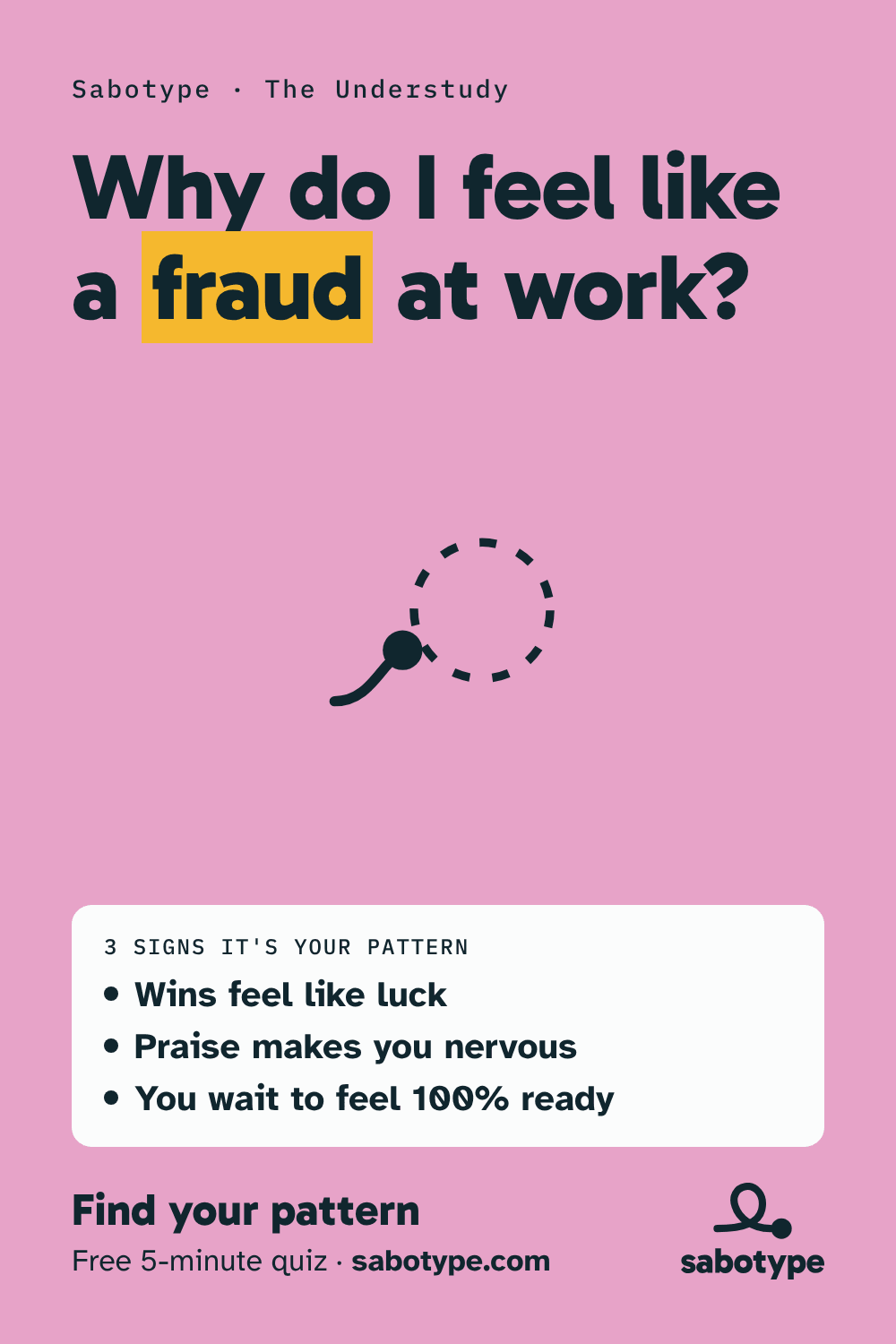
Why you feel like a fraud, even when you're doing well
It's not you. You may be capable of the lead role but sure you're only filling in. Psychologists call these impostor feelings. We call this pattern the Understudy.
Free · about 5 minutes · no email needed for your result
How it shows up in daily life
The same loop can look different in each part of life. You might recognize one area, or all four.
Direction & work
You don't apply unless you meet every single requirement. When your manager praises you, you wait for the “but.”
Love
You worry that once someone really knows you, they'll be disappointed. So you keep part of yourself in the wings.
Money
You undercharge for your work, or you feel awkward asking for a raise you've clearly earned.
Success & growth
Wins feel like luck or timing. You thank the team, the timing, the kind manager: anyone but yourself.
The tell: every success comes with an explanation that isn't you.
Why it happens, in plain words
In 1978, psychologists Pauline Clance and Suzanne Imes described high achievers who credited their success to luck, timing or other people, and who quietly feared being “found out” [1]. They called it the impostor phenomenon.
These feelings are common. A 2020 review of 62 studies found reported rates ranging from 9% to 82%, depending on the group and how it was measured [2]. They show up in people who are clearly doing well, often right after a promotion, a new job or a big win.
Here's the loop many people describe. Each success gets explained away, so it never adds to your sense of being capable. The next challenge feels just as scary, so you over-prepare. When it goes well, the credit goes to all that extra effort, or to luck, and the loop starts again.
What it protects, and the strength inside it
Waiting in the wings protects you from being seen and evaluated before you feel ready. Crediting luck also keeps expectations low, so a stumble later won't feel like being “found out.” The trade-off is that your evidence never piles up, so confidence has nothing to stand on.
Humility, diligence and being easy to coach. You keep learning when others stop. You don't need to become arrogant to step forward. You just need your own evidence to count.
3 tiny things to try today
Pick one. Small on purpose: the goal is a rep, not a transformation.
Start an evidence note
Open a note called “Evidence.” In 2 minutes, write three things you did well this year and who they helped. Keep it; you'll add to it.
Say “thank you” and stop
Next time someone praises you, say “Thank you” and nothing else. No “it was nothing,” no “I got lucky.”
Put your name in at “mostly ready”
If you meet most of what a role or project asks for, apply or volunteer anyway. Let them decide whether you're ready, instead of deciding for them.
When to talk to a professional
Doubting yourself now and then is human. Consider talking to a doctor or a licensed mental health professional if self-doubt keeps you from things you want for months, if the pressure to prove yourself leaves you exhausted, or if you feel low or hopeless for weeks at a time. A primary care doctor is a good first step and can point you to the right person [3]. If you ever feel unsafe or think about harming yourself, please reach out now: in the US, call or text 988; anywhere else, find a free line at findahelpline.com [4].
Is this your pattern?
The free quiz looks at six common patterns across work, success, money and love. It shows the one you lean on most, its hidden strength, and one small step for today.
Find your SabotypeFree · about 5 minutes · no email needed for your result
Questions people ask
Why do I feel like a fraud at work?
Often because your successes get explained away as luck, timing or help from others, so they never feel like proof of your ability. It's especially common after a promotion or a new role, when the stakes feel higher.
Are impostor feelings a diagnosis?
No. Impostor feelings aren't a medical diagnosis. Researchers call it the impostor phenomenon. The Understudy is our name for the everyday pattern.
Does feeling like a fraud mean I'm not good enough?
No. The feeling shows up in many people who are clearly capable. It's a pattern in how you explain your wins, not a measure of your skill.
How do I stop feeling like a fraud?
Start by letting your wins count. Keep a written record of what you did well, accept praise without deflecting it, and notice when you credit luck for something you worked for.
Guides on this pattern
The other 5 Sabotypes
Self-reflection, not a diagnosis
The Understudy is our name for an everyday behavior pattern, not a clinical term or a label for who you are. Sabotype is a self-reflection tool, not therapy or a diagnosis. If you're struggling, please reach out to a professional or a local helpline.
Sources
- Clance, P. R., & Imes, S. A. (1978). The imposter phenomenon in high achieving women: Dynamics and therapeutic intervention. Psychotherapy: Theory, Research & Practice, 15(3), 241–247. doi.org/10.1037/h0086006
- Bravata, D. M., Watts, S. A., Keefer, A. L., et al. (2020). Prevalence, predictors, and treatment of impostor syndrome: A systematic review. Journal of General Internal Medicine, 35(4), 1252–1275. doi.org/10.1007/s11606-019-05364-1
- National Institute of Mental Health. Help for mental illnesses (how to find help and a provider). nimh.nih.gov/health/find-help
- 988 Suicide & Crisis Lifeline (US): call or text 988, free, 24/7. 988lifeline.org
- Find A Helpline: free, confidential helplines in 130+ countries. findahelpline.com