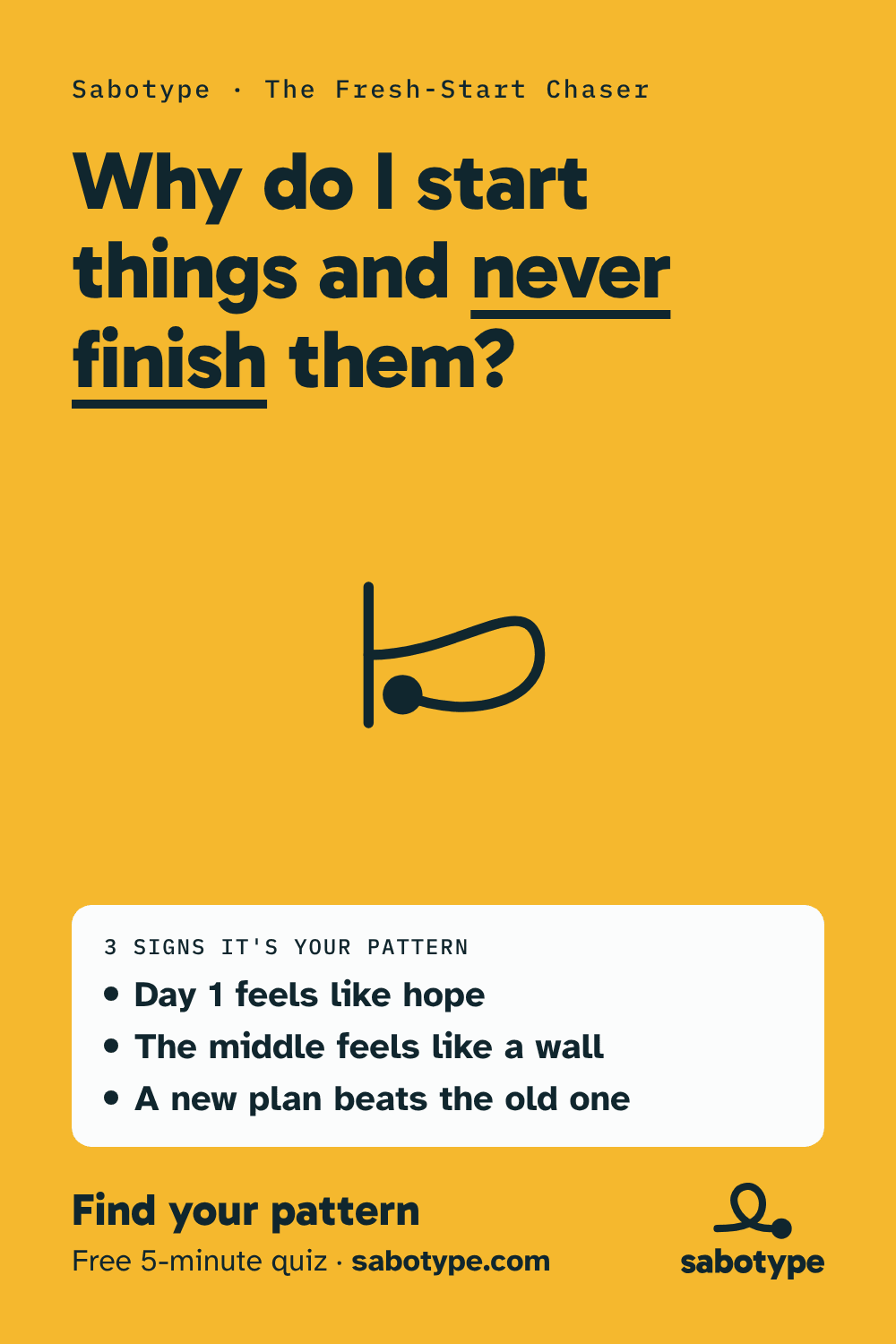
Sabotype · The Fresh-Start Chaser
Why you keep starting over, and rarely finish
It's not you. You may run on the spark of beginnings, and the middle feels like a wall. Psychologists have studied this loop, and it hides a real strength. We call it the Fresh-Start Chaser.
Free · about 5 minutes · no email needed for your result
How it shows up in daily life
The same loop can look different in each part of life. You might recognize one area, or all four.
Direction & work
A folder of half-built side projects. A course you paid for that stopped at module three. The first week felt electric; by week three it felt like homework.
Love
The early weeks of dating feel alive. When things settle into routine, the spark fades, and you start wondering what else is out there.
Money
A new budget app every January. A savings plan that runs strong for a month, then quietly stops once it gets boring.
Success & growth
You stop right before results would show: the gym habit dropped at week five, the blog paused at post nine.
The tell: you feel most like yourself on Day 1.
Why it happens, in plain words
Beginnings feel good for a reason. Researchers at Wharton found that people take on new goals more often after “fresh start” moments, like a new week, a new month or a birthday [1]. Those dates feel like a clean break from past slip-ups. A new plan lets you meet a better version of yourself, right now.
The middle feels different. Studies of goal pursuit suggest motivation tends to sag in the middle stretch, when the start is far behind and the finish is still far away [2]. Nothing new is happening, and progress is hard to see.
Procrastination researchers describe putting things off as short-term mood repair: it feels better now and hands the cost to later [3]. A brand-new project is one of the fastest mood lifts there is. So the loop isn't really about willpower. It's about which feeling wins in the moment.
What it protects, and the strength inside it
Starting over protects you from the flat, unglamorous feeling of the middle, and from finding out that the finished thing might be ordinary. A fresh plan keeps the dream intact. That's a very human trade. It just means the projects you care about most can sit at 20% for years.
The same wiring gives you real gifts: curiosity, fast learning and the nerve to begin. Most people never start. You start easily. The skill to add isn't more discipline. It's a way through the middle.
3 tiny things to try today
Pick one. Small on purpose: the goal is a rep, not a transformation.
Do the next 2-minute step
Pick one unfinished thing. Set a timer for 2 minutes and do only its very next tiny step. Stopping when the timer ends still counts.
Open a parking lot
When a shiny new idea shows up, write it on a “parking lot” note instead of starting it, plus one line on when you'll look at it (say, Sunday). Research suggests a concrete plan for an unfinished goal quiets its pull on your attention [4].
Write one if–then plan
“If I feel the urge to start over, then I'll give the current thing 5 minutes first.” Across 94 tests, specific if–then plans like this helped people follow through [5].
When to talk to a professional
Starting over now and then is human. Consider talking to a doctor or a licensed mental health professional if this pattern leaves you stuck or low most days for a few weeks, if it's causing real trouble at work, with money or in your relationships, or if focusing and finishing have been hard for as long as you can remember. A primary care doctor is a good first step and can point you to the right person [6]. If you ever feel unsafe or think about harming yourself, please reach out now: in the US, call or text 988; anywhere else, find a free line at findahelpline.com [7].
Is this your pattern?
The free quiz looks at six common patterns across work, success, money and love. It shows the one you lean on most, its hidden strength, and one small step for today.
Find your SabotypeFree · about 5 minutes · no email needed for your result
Questions people ask
Why do I always want to start over?
Fresh starts feel like a clean break from past slip-ups, so a new plan brings a quick lift. Meanwhile motivation tends to dip in the middle of any goal, when progress is hard to see. Put those together and starting over can feel better than pushing through.
Is it bad to start lots of things and finish few?
Not always. Exploring is how you find what fits. It becomes a problem when the unfinished pile weighs on you, or when the things you drop are the ones you care about most.
How do I actually finish what I start?
Make the middle smaller. Work on one project at a time, park new ideas on a list, use an if–then plan for the moment you want to quit, and start with 2-minute steps so beginning again is easy.
Is the Fresh-Start Chaser a diagnosis?
No. It's our name for an everyday behavior pattern, not a diagnosis or a label for life. If focusing and finishing have been hard for as long as you can remember, a doctor can help you look into why.
Guides on this pattern
The other 5 Sabotypes
Self-reflection, not a diagnosis
The Fresh-Start Chaser is our name for an everyday behavior pattern, not a clinical term or a label for who you are. Sabotype is a self-reflection tool, not therapy or a diagnosis. If you're struggling, please reach out to a professional or a local helpline.
Sources
- Dai, H., Milkman, K. L., & Riis, J. (2014). The fresh start effect: Temporal landmarks motivate aspirational behavior. Management Science, 60(10), 2563–2582. doi.org/10.1287/mnsc.2014.1901
- Bonezzi, A., Brendl, C. M., & De Angelis, M. (2011). Stuck in the middle: The psychophysics of goal pursuit. Psychological Science, 22(5), 607–612. doi.org/10.1177/0956797611404899
- Sirois, F., & Pychyl, T. (2013). Procrastination and the priority of short-term mood regulation: Consequences for future self. Social and Personality Psychology Compass, 7(2), 115–127. doi.org/10.1111/spc3.12011
- Masicampo, E. J., & Baumeister, R. F. (2011). Consider it done! Plan making can eliminate the cognitive effects of unfulfilled goals. Journal of Personality and Social Psychology, 101(4), 667–683. doi.org/10.1037/a0024192
- Gollwitzer, P. M., & Sheeran, P. (2006). Implementation intentions and goal achievement: A meta-analysis of effects and processes. Advances in Experimental Social Psychology, 38, 69–119. doi.org/10.1016/S0065-2601(06)38002-1
- National Institute of Mental Health. Help for mental illnesses (how to find help and a provider). nimh.nih.gov/health/find-help
- 988 Suicide & Crisis Lifeline (US): call or text 988, free, 24/7. 988lifeline.org
- Find A Helpline: free, confidential helplines in 130+ countries. findahelpline.com