Sabotype · The Echo
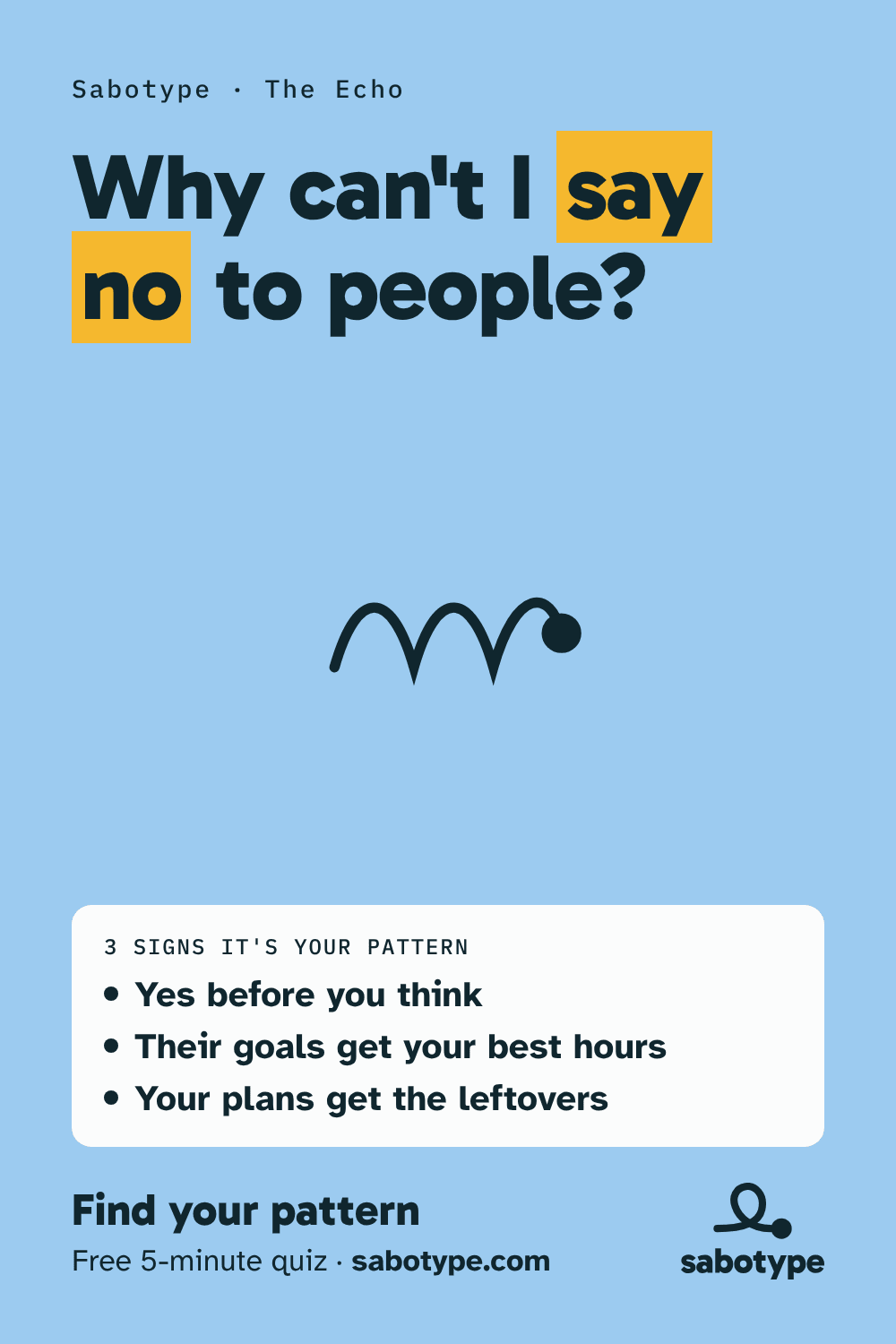
Why you can't say no, and always put others first
It's not you. Your time and effort may go to everyone else's goals before they reach yours. Many people call it saying yes to everyone. We call this pattern the Echo.
Free · about 5 minutes · no email needed for your result
How it shows up in daily life
The same loop can look different in each part of life. You might recognize one area, or all four.
Direction & work
You take on a coworker's task “just this once,” every week. Your own priorities get done at 9 p.m., if at all.
Love
You agree to plans you don't want, then feel quietly resentful. Over time you lose track of what you actually like.
Money
You lend money or pick up the bill to keep the peace, even when it strains your budget.
Success & growth
You wait for someone's permission or approval before going after what you want.
The tell: “yes” comes out before you've checked with yourself.
Why it happens, in plain words
Psychologists Jennifer Crocker and Connie Wolfe describe how people rest their sense of worth on different things [1]. When a lot of yours rests on other people's approval, every request can feel like a test of whether you're a good person.
Each yes brings quick relief: the tension drops and the other person smiles. That relief makes the next yes easier. Over time, other people's goals get your best hours, and your own plans get whatever is left at the end of the day.
The good news: saying no may cost less than you fear. In a set of studies, people who turned down an invitation overestimated how upset the other person would be [2]. Most people take a kind, clear no far better than we expect.
What it protects, and the strength inside it
Saying yes protects your relationships, or at least it feels that way. It keeps conflict off the table and keeps you seen as the helpful one. The trade-off is that people rarely get to know what you actually want, and your own goals stay on hold.
Empathy, generosity and a gift for reading people. Those make you a great friend and teammate. The goal isn't to stop caring. It's to include yourself in the people you care for.
3 tiny things to try today
Pick one. Small on purpose: the goal is a rep, not a transformation.
Pause for three
Before the next request today, pause and count to three. Ask yourself, “Do I want to?” Then answer. That pause is the whole exercise.
Use a bridge phrase
Buy time instead of saying yes on the spot: “Let me check and get back to you tonight.” A delayed answer is easier to make honest.
Protect one slot
Block 20 minutes on your calendar for your own goal. Keep it the way you'd keep a meeting with someone you respect. Because it is one.
When to talk to a professional
Wanting people to be okay is a good thing. Consider talking to a doctor or a licensed mental health professional if guilt or worry about others' reactions fills most of your days, or if you feel drained or low for weeks. And if someone in your life makes saying no feel unsafe, through anger, threats or control, please talk to someone you trust or a support line. A primary care doctor is a good first step and can point you to the right person [3]. If you ever feel unsafe or think about harming yourself, please reach out now: in the US, call or text 988; anywhere else, find a free line at findahelpline.com [4].
Is this your pattern?
The free quiz looks at six common patterns across work, success, money and love. It shows the one you lean on most, its hidden strength, and one small step for today.
Find your SabotypeFree · about 5 minutes · no email needed for your result
Questions people ask
Why can't I say no to people?
Often because a lot of your sense of worth rests on others' approval, so a no feels risky. Each yes brings quick relief, which makes the next one easier. It's a learned habit, and habits can shift with practice.
Is saying yes to everyone the same as being kind?
Not quite. Kindness is a choice you make freely. The automatic yes happens because a no feels too uncomfortable, even when it costs you.
How do I say no without feeling guilty?
Start small and keep it short: “Thanks for asking, I can't this time.” Some guilt at first is normal and tends to fade. Research suggests people take a no better than we expect.
Is the Echo a diagnosis?
No. It's our name for an everyday behavior pattern, not a diagnosis or a label for who you are.
Guides on this pattern
The other 5 Sabotypes
Self-reflection, not a diagnosis
The Echo is our name for an everyday behavior pattern, not a clinical term or a label for who you are. Sabotype is a self-reflection tool, not therapy or a diagnosis. If you're struggling, please reach out to a professional or a local helpline.
Sources
- Crocker, J., & Wolfe, C. T. (2001). Contingencies of self-worth. Psychological Review, 108(3), 593–623. doi.org/10.1037/0033-295X.108.3.593
- Givi, J., & Kirk, C. P. (2024). Saying no: The negative ramifications from invitation declines are less severe than we think. Journal of Personality and Social Psychology. doi.org/10.1037/pspi0000443
- National Institute of Mental Health. Help for mental illnesses (how to find help and a provider). nimh.nih.gov/health/find-help
- 988 Suicide & Crisis Lifeline (US): call or text 988, free, 24/7. 988lifeline.org
- Find A Helpline: free, confidential helplines in 130+ countries. findahelpline.com