Sabotype · The Hedger
Why you hold back, right when it matters most
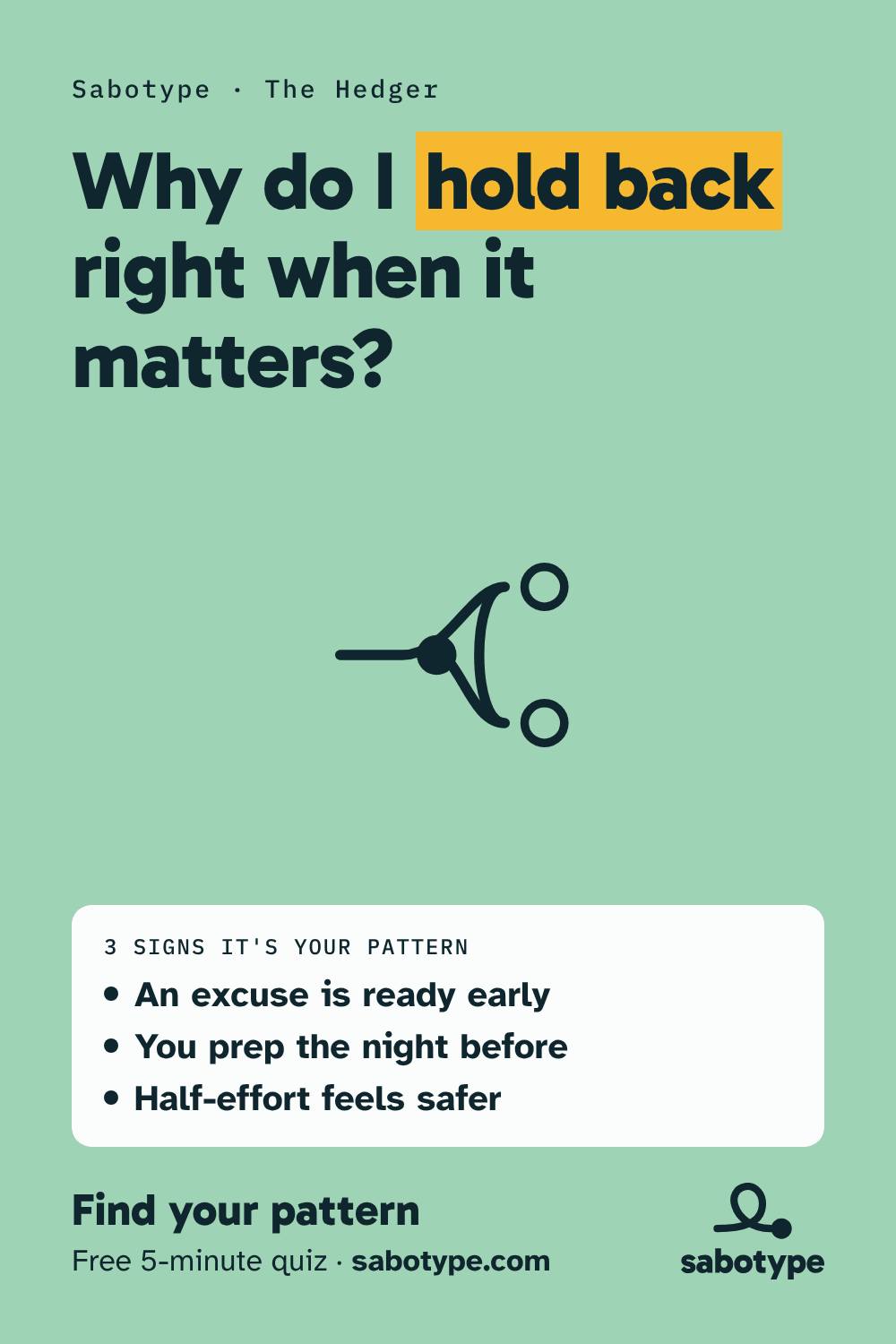
It's not you. Holding a little back may protect you from finding out what full effort would show. Psychologists call it self-handicapping. We call this pattern the Hedger.
Free · about 5 minutes · no email needed for your result
How it shows up in daily life
The same loop can look different in each part of life. You might recognize one area, or all four.
Direction & work
You start preparing the night before the interview, then tell yourself you work better under pressure. You pick the safe role so a stretch role can't put you to the test.
Love
You keep one foot out the door. If you never fully commit, a breakup can't really say anything about you.
Money
“I'm just bad with money” becomes the reason not to learn the thing you're scared you'd struggle with.
Success & growth
Right before a big moment, something gets in the way: a late night, a skipped practice, a “busy week.”
The tell: the reason is ready before the result is.
Why it happens, in plain words
In 1978, psychologists Edward Jones and Steven Berglas named this move self-handicapping: putting an obstacle in your own way before something that matters [1]. If it goes badly, you have a reason that isn't about your ability. If it goes well, you look even more capable.
In their classic study, people got a good score they weren't sure they'd earned. Before a retest, many chose a drug they were told would hurt their performance [2]. The handicap gave them cover. It's a clever shield for how you see yourself, and almost everyone uses it sometimes.
The cost is real, though. A 2014 review of many studies linked self-handicapping with lower achievement [3], and another study linked it with lower well-being over time [4]. The shield protects your self-image, but it also caps how far you go.
What it protects, and the strength inside it
Holding back protects your sense of what you could do. As long as you never give full effort, the question stays open, and an open question can feel safer than a clear answer. The trade-off is that you never get to feel what a real, full-effort win is like.
You see risk clearly, and you often stay steady when others panic. That's worth keeping. The work is separating your worth from the result, so full effort feels safer to give.
3 tiny things to try today
Pick one. Small on purpose: the goal is a rep, not a transformation.
Spot your ready-made reason
Before something that matters today, check whether an excuse is already lined up (“I didn't sleep anyway”). Just write it down. Naming it takes away some of its pull.
Run a 2-minute all-in test
Pick one small task that matters a little. For 2 minutes, give it your full effort, with nothing held back. Afterward, notice how that felt.
Make it about learning, not proving
Set a goal like “learn one thing from this” instead of “prove I'm good.” Research reviewed by Tim Urdan and Carol Midgley found students used fewer self-handicaps in classrooms focused on learning and improving rather than beating others [5].
When to talk to a professional
Holding back now and then is human. Consider talking to a doctor or a licensed mental health professional if the “handicap” is often drinking, other substances or night after night of little sleep, if the pattern keeps costing you jobs, grades or relationships, or if you feel stuck or low for weeks. A primary care doctor is a good first step and can point you to the right person [6]. If you ever feel unsafe or think about harming yourself, please reach out now: in the US, call or text 988; anywhere else, find a free line at findahelpline.com [7].
Is this your pattern?
The free quiz looks at six common patterns across work, success, money and love. It shows the one you lean on most, its hidden strength, and one small step for today.
Find your SabotypeFree · about 5 minutes · no email needed for your result
Questions people ask
Why do I give up before I even try?
Often it's protection. If you don't fully try, a poor result can't say much about your ability. Psychologists call this self-handicapping. It shields how you see yourself in the short term, but it limits what you find out you can do.
What are examples of self-handicapping?
Studying at the last minute, skipping practice before a big game, staying out late before an interview, choosing a goal that's far too easy or far too hard, or telling everyone in advance that you're sick or unprepared.
Is self-handicapping the same as procrastination?
They overlap. Putting things off can work as a handicap, because it gives you a ready reason if things go badly. Self-handicapping is the wider idea: any obstacle you put in your own way before a test of your ability.
Is the Hedger a diagnosis?
No. It's our name for an everyday behavior pattern that psychologists have studied for decades. It describes something you do in certain moments, not who you are.
Guides on this pattern
The other 5 Sabotypes
Self-reflection, not a diagnosis
The Hedger is our name for an everyday behavior pattern, not a clinical term or a label for who you are. Sabotype is a self-reflection tool, not therapy or a diagnosis. If you're struggling, please reach out to a professional or a local helpline.
Sources
- Jones, E. E., & Berglas, S. (1978). Control of attributions about the self through self-handicapping strategies: The appeal of alcohol and the role of underachievement. Personality and Social Psychology Bulletin, 4(2), 200–206. doi.org/10.1177/014616727800400205
- Berglas, S., & Jones, E. E. (1978). Drug choice as a self-handicapping strategy in response to noncontingent success. Journal of Personality and Social Psychology, 36(4), 405–417. doi.org/10.1037/0022-3514.36.4.405
- Schwinger, M., Wirthwein, L., Lemmer, G., & Steinmayr, R. (2014). Academic self-handicapping and achievement: A meta-analysis. Journal of Educational Psychology, 106(3), 744–761. doi.org/10.1037/a0035832
- Zuckerman, M., & Tsai, F.-F. (2005). Costs of self-handicapping. Journal of Personality, 73(2), 411–442. doi.org/10.1111/j.1467-6494.2005.00314.x
- Urdan, T., & Midgley, C. (2001). Academic self-handicapping: What we know, what more there is to learn. Educational Psychology Review, 13(2), 115–138. doi.org/10.1023/A:1009061303214
- National Institute of Mental Health. Help for mental illnesses (how to find help and a provider). nimh.nih.gov/health/find-help
- 988 Suicide & Crisis Lifeline (US): call or text 988, free, 24/7. 988lifeline.org
- Find A Helpline: free, confidential helplines in 130+ countries. findahelpline.com